

 English
Termination of the validity of a Tax Identification Number (TIN or tax code), or TIN deregistration, is a mandatory step in the procedures for the dissolution or termination of operations of enterprises and organizations in Vietnam. This article provides a detailed guide to the procedures and practical considerations for TIN deregistration under the latest regulations applicable in 2026.
This article focuses on taxpayers that are commonly established organizations in Vietnam, including enterprises and their dependent units; branches and representative offices of foreign traders in Vietnam; and foreign contractors and foreign subcontractors that have been issued a Vietnamese TIN, in the following circumstances:
- Termination of business operations or dissolution
- No more tax obligations arising for non-business organizations
- Foreign contractors and foreign subcontractors upon termination of contracts
The content of the article is based on the latest provisions in the Law on Tax Administration 2025 and Circular 90/2026/TT-BTC, both of which took effect on 1 July 2026.
Classification of taxpayers subject to TIN deregistration procedures
Taxpayers undergoing termination of the validity of their TIN are classified into two groups based on different dossier submission methods:
- Taxpayers processed under the inter-agency one-door mechanism: enterprises established in Vietnam.
- Taxpayers processed directly at tax authorities: dependent units of enterprises; branches, representative offices of foreign traders in Vietnam; foreign contractors/subcontractors in Vietnam.
4-step procedure for TIN deregistration
The TIN deregistration process includes 4 main steps that taxpayers are required to follow.
Step 1. Review tax compliance status
Before officially submitting a request for termination of the validity of TIN, Taxpayers need to review their tax compliance status either by themselves or through a service provider to minimize the risks of additional tax assessments and tax penalties that may arise in subsequent steps. The mandatory review scope includes 4 key groups of contents:
- Review overall financial obligations: social insurance, customs obligations (if import/export activities arise), salaries, employee allowances, debts payable to customers and partners, and completion of asset liquidation procedures.
- Review and submit additional missing tax declaration dossiers: Review the entire system of tax declaration dossiers (monthly, quarterly, annually or upon occurrence) from the commencement of operation until the time of dissolution. The types of taxes to be reviewed include: Value Added Tax, Corporate Income Tax, Personal Income Tax, Business License Fee, Foreign Contractor Tax and tax allocation obligations in other locations (if any). In case of detecting errors, the taxpayer proactively submit supplementary tax declaration dossiers before the tax authority announces the tax inspection or examination decision.
- Review invoices, vouchers and accounting books: Review all issued e-invoice data, completely handle erroneous invoices (adjusted invoices, replacement invoices, cancelled invoices) and unused invoices on the e-tax system. For long-established enterprises that used paper invoices before 1 July 2022, it is necessary to review the implementation of transitional obligations under Decree No. 123/2020/ND-CP, including the report on the use of invoices, procedures for cancelling unused paper invoices and submission of the notice of results of paper invoice cancellation as prescribed.
- Completion of the termination of tax invalidation of dependent units (if any): In case the managing unit such as an enterprise has dependent units such as branches and representative offices that have been granted TINs, the managing unit must send a written notice of termination of operation to the dependent units to request the dependent units to carry out procedures for termination of validity of TIN with the tax authority managing the dependent units before termination of validity of TIN of the managing unit. If the dependent unit is unable to fulfill tax obligations, the managing unit must make a written commitment to assume such obligations.
Step 2. Prepare and submit the dossier
1. For taxpayers that comply with the inter-agency one-door administrative mechanism
The dossier for TIN deregistration of an enterprise is the enterprise dissolution notification dossier, which include the following documents:
- Minutes of the meeting and decision on dissolution of the enterprise
- Debt settlement plan, in cases where the enterprise still has unpaid financial obligations
- Written request for confirmation of fulfillment of tax payment obligations for imported and exported goods (if the enterprise has a customs code)
The submission of the dossiers shall be carried out as follows:
- The enterprise shall approve the Resolution/Decision on dissolution and the Minutes of the meeting, then submit the dissolution notification dossier to the Business Registration Authority within 07 working days from the date of the decision is approved.
- State agencies process under the inter-agency mechanism: The Business Registration Authority updates the legal status of the enterprise on the National Enterprise Registration Information System to the status of “Undergoing dissolution procedures”, and automatically transfers the connected data to the directly managing tax authority. The tax authority issues Notice No. 17/TB-DKT (on the taxpayer ceasing operation and carrying out procedures for termination of validity of TIN), and simultaneously changes the TIN status of the enterprise to Status 03 (Ceasing operation but not yet completing procedures for termination of validity of TIN).
2. For taxpayers carrying out procedures directly at tax authorities
The dossier for TIN deregistration includes the following documents:
- Written request for termination of validity of TIN: Form No. 24/DKT
- For managing units: the decision on dissolution
- For dependent units: the decision or notice of termination of operation of dependent units
- For foreign contractors and foreign subcontractors: a copy of contract liquidation and documents proving the completion of tax obligations in Vietnam.
The taxpayer shall submit the dossier for termination of validity of TIN to the directly managing tax authority within 10 working days from the date of issuance of the internal document on termination of operation.
Step 3. Work with tax authorities
This is the most complicated and time-consuming step to complete the termination of validity of TIN. The taxpayer needs to closely coordinate with tax authorities to perform the following 4 major groups of tasks:
- Submission of final tax finalization dossiers: the taxpayer is required to prepare and submit CIT finalization dossiers and PIT finalization dossiers up to the date of approval of the dissolution decision within a maximum period of 45 days from the date of approval of the dissolution Resolution/Decision. In case the taxpayer incurs foreign contractor tax, the deadline for submission of foreign contractor tax finalization dossiers is 45 days from the date of termination of the foreign contractor contract.
- Coordination in tax finalization inspection at the head office: Based on tax administration risk analysis results, tax law compliance history, and invoice declaration status, the tax authority will determine whether to conduct tax finalization inspection at the tax authority’s office or issue a decision on tax inspection at the taxpayer’s head office. The taxpayer needs to fully prepare and scientifically arrange accounting books, annual financial statements, economic contracts together with liquidation records, non-cash payment documents, tax payment receipts, invoice dossiers, etc., and appoint qualified personnel to provide explanations promptly at the request of the inspection team.
- Confirmation of completion of inter-agency customs obligations: For the taxpayers that have registered and incurred import/export activities, the tax authority will send a written request for data coordination with the customs authority to determine whether the taxpayer has fulfilled all tax payment obligations related to import/export activities before proceeding with TIN deregistration.
- Definitive settlement of remaining financial obligations: The tax authority determines the exact payable tax amount, outstanding tax debts, late payment interest, administrative violation fines (if any), overpaid tax amounts, and VAT amounts that have not been fully deducted. The taxpayer shall fully pay outstanding tax debts and fines into the state budget. For overpaid tax amounts, the taxpayer shall submit a dossier requesting tax refund or offsetting in accordance with regulations. If the enterprise has dependent units (branches, representative offices, business locations) with unfulfilled tax obligations, the enterprise must completely settle such obligations or carry out procedures for transfer and succession of tax obligations in accordance with regulations before the managing unit is confirmed as having completed its obligations.

Step 4. Receive a notice of completion of tax obligations
1. For the taxpayers carrying out procedures under the inter-agency one-door administrative mechanism
Within 05 working days, the enterprise shall complete the payment of tax, late payment interest and fines (if any) according to the handling results. The tax authority issues a Notice on the taxpayer’s completion of tax obligations for submission of the dissolution/termination of operation dossier to the Business Registration Authority, using Form No. 28/TB-ĐKT.
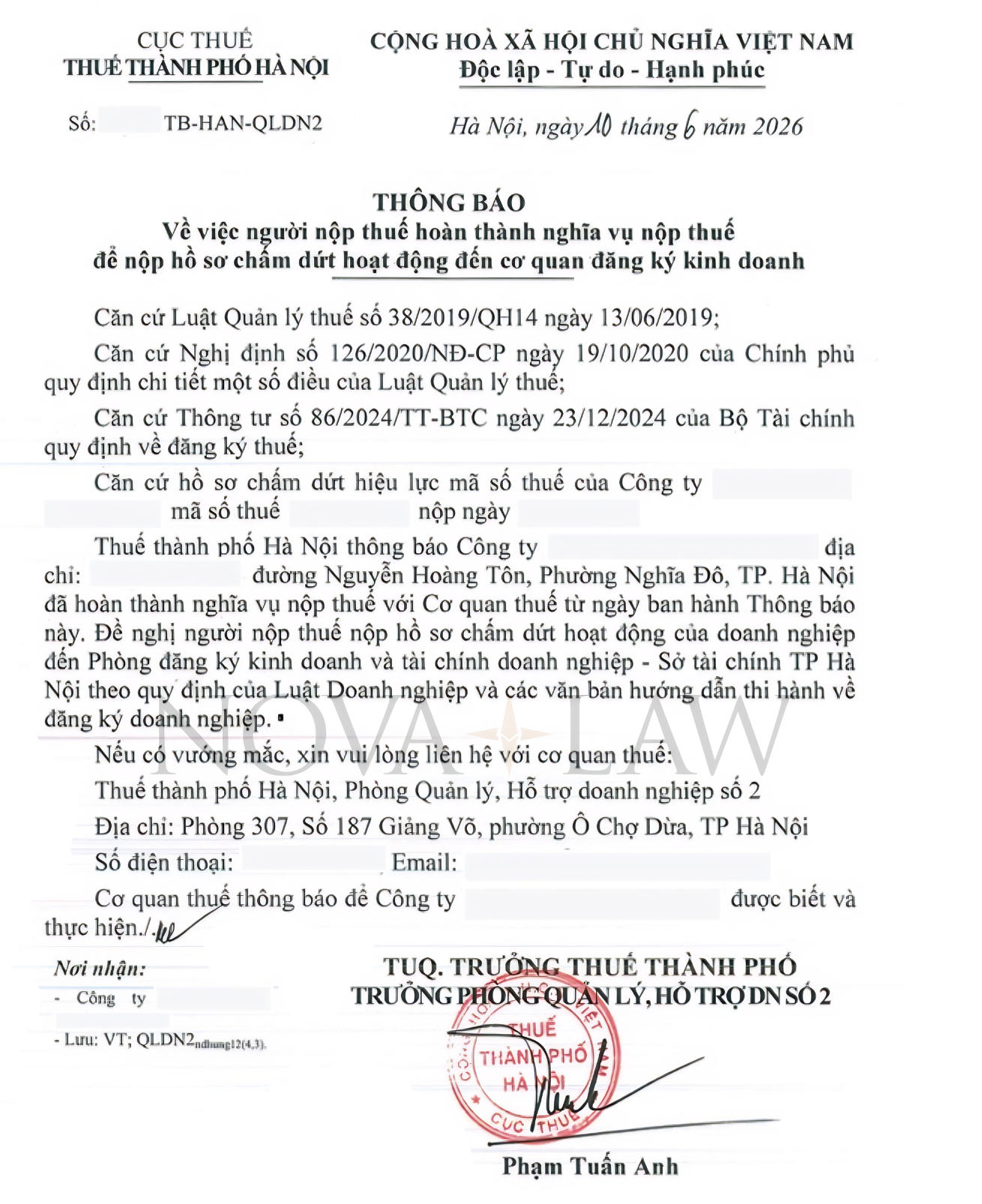
However, the TIN of the enterprise is only terminated after the enterprise completes the dissolution procedures with the Business Registration Authority.
2. For the taxpayers carrying out procedures directly at tax authorities
The taxpayer completes the payment of tax, late payment interest and fines (if any) according to the handling results of the tax authority. The tax authority issues a Notice on termination of validity of TIN of the taxpayer, Form No. 18/TB-ĐKT.
The taxpayer cannot be considered as having been legally dissolved if tax obligations have not been completed and the tax authority has not confirmed the termination of validity of TIN. In other words, the status of “dissolution dossier submitted” and “dissolution completed” are two completely different legal milestones.
How long does it take to complete TIN deregistration?
How long does it take to deregister a TIN?
The total estimated time for TIN deregistration for simple dossiers without arising issues is approximately 4-6 months.
The total estimated time for TIN deregistration for complex dossiers may take 6 – 12 months or more.
| Procedure | Time as prescribed/actual |
| Step 1. Review tax compliance status | Depending on the status of the enterprise; in practice, it usually takes 2–4 months depending on the size of the dossier and accounting records. |
| Step 2. Preparation and submission of dossiers for termination of validity of TIN | Inter-agency one-stop mechanism: 7 working days from the date of approval of the dissolution decision. Direct submission to tax authority: 10 working days from the date of issuance of the document on termination of operation. |
| Step 3. Working with tax authorities (submission of final tax finalization dossiers and tax finalization inspection) | Submission of tax finalization dossiers: maximum 45 days from the date of approval of the dissolution decision/termination of the contractor contract. Tax finalization inspection: no statutory time limit (in practice, approximately 4–6 months and may be longer if the dossier is complicated or inspection is conducted at the head office). |
| Step 4. Receive Notice of completion of tax obligations/termination of validity of TIN | Approximately 5 working days after completion of payment of tax and fines. |
Common challenges and solutions
Below are common problems encountered when carrying out procedures for termination of validity of TIN and solutions based on Nova Law’s practical experience.
1. The tax finalization inspection takes a long time, and coordination between tax authorities and customs authorities is delayed
Problems: The inspection and determination of final tax obligations have no statutory time limit. The taxpayer may be stuck at this stage for the longest period, especially in cases where an inspection is conducted at the head office. For the taxpayer conducting import/export activities, confirmation of completion of customs obligations also often takes longer than expected due to the inter-agency process.
Solution: Enterprises need to carefully review and prepare sufficient documents proving invoices and large-value/unusual transactions before approving the dissolution decision; prepare financial resources for possible additional tax assessments, late payment interest and fines; export manufacturing enterprises, processing enterprises and export processing enterprises should complete customs finalization reports and obligations early.
2. Dependent units “hang” and distort interdisciplinary data
Problems: Dependent units managed by tax authorities in other localities that have not completed their procedures may cause the managing unit to be unable to proceed; at the same time, the business registration system and tax registration system may sometimes update statuses inconsistently, requiring the taxpayer to check both systems in parallel.
Solution: The dependent units must be completely handled first. This is a mandatory principle because the tax authority will not confirm completion of obligations for the managing unit if there are still dependent units with unresolved obligations.
3. Status 06 (not operating at the registered address)
Problem: Many enterprises have ceased actual operations but do not promptly handle the procedures, resulting in being transferred to Status 06. The longer the delay, the larger the volume of missing declarations and the higher the risk of administrative penalties compared with handling dissolution while the enterprise remains in normal operating status.
Solution: Review accounting records and carry out dissolution/TIN deregistration procedures as soon as there is an intention to cease operation, without waiting until the enterprise is transferred to Status 06; submit all missing declarations at the same time to apply more favorable penalty principles and avoid separate penalties for each individual violation.
4. Overpaid tax and VAT that have not been fully deducted are neglected
Problem: the taxpayer often focuses only on obtaining confirmation of TIN deregistration and forgets to continue monitoring tax refund dossiers, while this represents the enterprise’s actual financial rights.
Solution: the taxpayer proactively monitors and completes tax refund/offset dossiers in parallel with the process of termination of validity of TIN; at the same time, fully retain all dossiers after completion (tax finalization declarations, financial statements, tax payment documents, and notices issued by tax authorities), as explanation obligations may still arise in case of future retrospective inspections or examinations.
TIN deregistration services
With practical experience in supporting many foreign organizations in Vietnam during tax finalization processes, Nova Law provides comprehensive TIN deregistration support services to help clients shorten processing time, minimize legal risks and ensure completion of procedures in accordance with applicable laws.
- Pre-tax audit service: Nova Law’s accounting and tax experts will review the entire system of e-invoices, tax declarations and accounting records throughout the enterprise’s operation period to identify potential risks, guide the enterprise in completing supporting documents and making supplementary declarations before submitting the dossier for termination of validity of TIN.
- Tax audit assistance: Nova Law’s experienced experts will support enterprises during the tax inspection/examination process, including preparing documents required by the tax authority, providing technical explanations, participating in meetings and presenting opinions to optimize tax obligations and protect the lawful rights and interests of enterprises.
- Tax appeal service: In case the enterprise disagrees with any contents stated in the tax inspection conclusion issued by the tax authority, Nova Law will provide advice, develop a strategy and support the enterprise in appealing such contents to the competent higher-level tax authority to protect the enterprise’s rights and interests.
- Full-service procedure representation: Nova Law represents the taxpayer in preparing all valid dossiers, submitting applications and directly working and providing explanations to the managing tax authority and the Business Registration Authority to promptly resolve arising issues.
- Handling difficult and pending dossiers: Specialized support for cases where the taxpayer’s TIN is locked (Status 06), dependent units in other provinces have unresolved obligations, invoices or documents are lost, or changes of legal representatives are required during the dissolution process.
- Tax refund benefit optimization advisory: Nova Law supports the taxpayer in preparing dossiers for refund of overpaid taxes and lawful offsetting of inter-province tax obligations in a timely manner.
Contact Nova Law to receive a quotation from our lawyers and tax consultants for TIN deregistration services


