English
Discover 11 essential post-incorporation procedures for newly established FDI companies in Vietnam to stay compliant with the latest regulations in 2026.
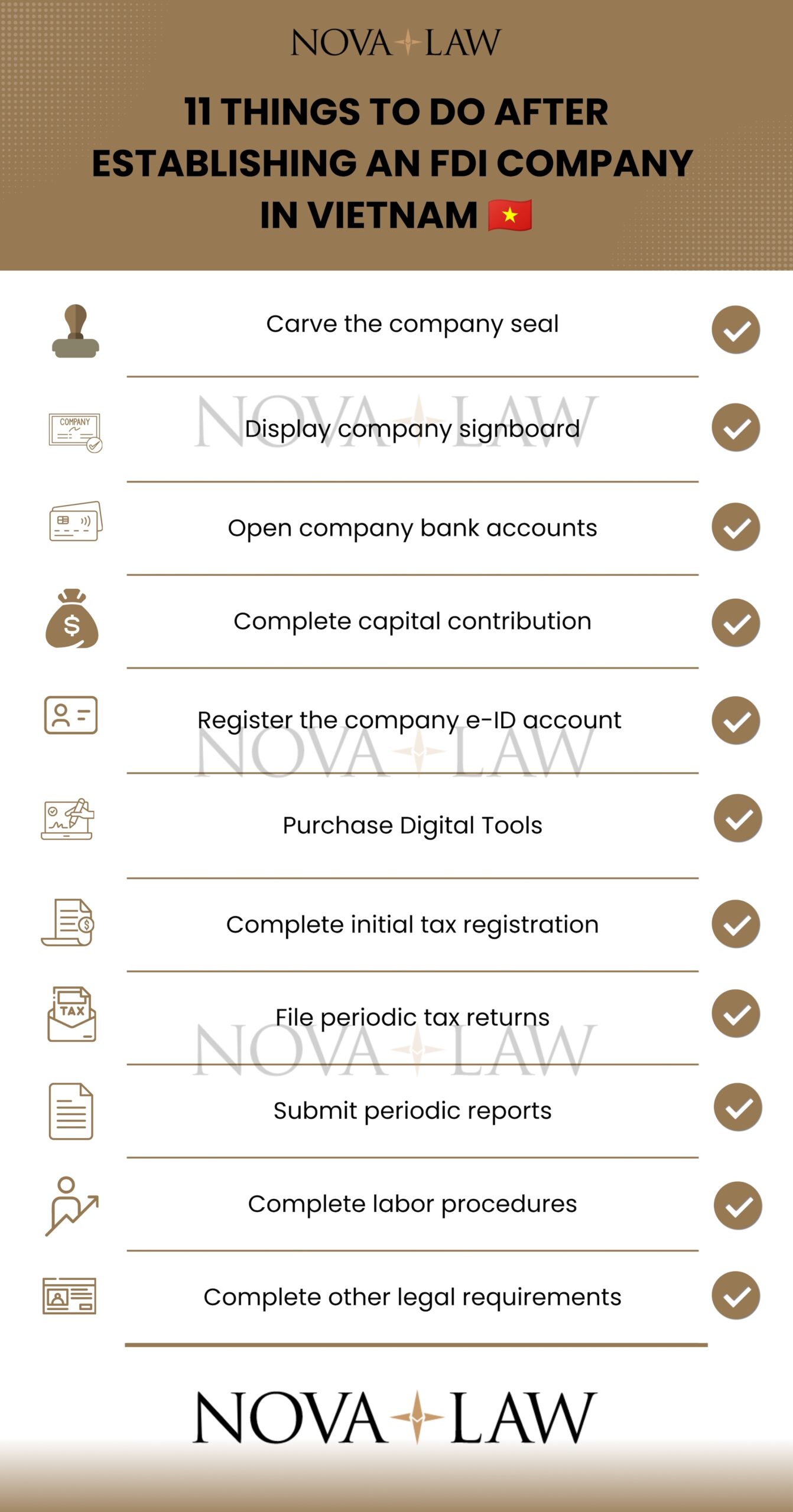
1. Carve the company seal
The company seal includes a seal made at an engraving facility or a seal in the form of a digital signature in accordance with the law on electronic transactions. The company shall decide on the type, quantity, form, and content of the seal of the company, its branches, representative offices, and other units of the company. The management and retention of the seal shall be carried out in accordance with the Company Charter or regulations issued by the company, branch, representative office, or other unit of the company that owns the seal. The company shall use the seal in transactions in accordance with the law.

2. Display the company signboard
The company is required to display the company signboard at its headquarters and maintain it throughout its operation.
Based on Article 34 of the current Law on Advertising, the signboard must generally include 4 details: the name of the managing organization (if applicable), the company’s name, address, and phone number. The tax code is not mandatory on the signboard, but it is recommended to include it. The signboard must comply with the applicable size requirement, content, language, and safety. Vietnamese text should be placed above and displayed larger than foreign-language text. The signboard must not obstruct emergency exits or encroach on public roads or sidewalks.
Non-compliance may result in fines of VND 10 million to VND 40 million and mandatory removal of the signboard according to Decree No. 87/2026/ND-CP.

3. Open company bank accounts
An FDI company must open at least two bank accounts: a Direct Investment Capital Account (DICA), used for receipts and payments related to foreign investment activities, and a VND Current Account, used for day-to-day transactions such as contracts, salaries, and tax payments. The account-opening procedure varies by bank but generally requires the legal representative to be physically present for biometric identification, and can usually be completed within a day.
Learn more: How to use company bank accounts
4. Complete capital contribution
Foreign investors must transfer their capital contribution into the DICA within 90 days from the ERC issuance date, or a longer period if stated on the Investment Registration Certificate (IRC). Contributions in assets may exclude the time needed for transport, import, or ownership transfer. Once opened, the company must also register and link its banking information with the tax authority.
Late or insufficient capital contribution may result in a fine of VND 70 million to VND 100 million along with a mandatory adjustment of the charter capital to reflect the actual amount contributed.

5. Register the company e-ID account
From 1 July 2025, companies operating in Vietnam are required to use a company e-ID account for online administrative procedures, including tax-related procedures. The company e-ID account can be registered through VNeID by the company’s legal representative or an authorized person in accordance with applicable regulations. Once activated, the account can be used to access online government services.
Learn more: Guidance on Company e-ID Registration in Vietnam
6. Purchase digital tools
To support the company’s tax, accounting, social insurance, and other electronic transactions, the company will need to purchase and set up the following digital tools and software:
- USB digital signature device: A USB-shaped device containing a business entity’s digital certificate and private key. Every company in Vietnam is required to have at least one USB Token for electronically signing tax, customs, social insurance, immigration, and other e-transactions.
- VAT e-invoice software: A software platform connected to the tax authority’s system, used to create, issue, and manage electronic VAT invoices in accordance with Vietnamese e-invoicing regulations. Companies must register and use this software before issuing invoices or recognizing revenue from customers.
- Accounting software: A software system used to record, process, and store the company’s accounting data, such as revenue, expenses, and financial statements – in compliance with Vietnamese accounting standards, and to support the preparation of statutory reports for tax and audit purposes.
- E-declaration software for social insurance: A software platform used to submit and manage the company’s social insurance procedures electronically with the Social Insurance authority, including employee enrollment, contribution declarations, and adjustments to insurance records.

7. Complete initial tax registration
The company must complete the following tax procedures to avoid penalties or disruptions to its business operations.
- Activate the company’s e-tax account and enable e-tax payment.
- Submit the initial tax filing dossier to the directly managing tax authority, including the appointment of the chief accountant, the chosen accounting regime, and the fixed asset depreciation method (if applicable).
- Register to use e-invoices before issuing invoices or recognizing revenue from customers.
- Register an e-customs declaration account (if the company engages in import-export activities).
- Register a foreign contractor tax code (if the company makes payments to foreign contractors)
In addition, the company shall establish internal financial regulations to govern the company’s financial management, spending authority, and expense procedures.

8. File periodic tax returns
Companies operating in Vietnam must organize their accounting functions in accordance with Vietnamese accounting regulations. There are generally two options:
- Internal accounting function — suitable for companies with larger operations and regular accounting transactions.
- Outsourced accounting services — suitable for small and medium-sized businesses with relatively limited transactions, helping reduce the costs of maintaining an in-house accounting team.
Tax declaration is the taxpayer’s preparation and submission to the tax authority of tax declarations and related documents as a basis for determining the taxpayer’s tax obligations to the Vietnamese state budget.
For normal businesses, the types of tax reports that must be prepared include: value-added tax, personal income tax (if any), corporate income tax, import and export tax (if any), contractor (if any), year-end settlement report, and report on invoice usage.
In addition, businesses need to submit license fee declaration documents when newly established, when opening additional branches, or business locations, or when there are changes in capital.
Depending on its activities, a company may need to prepare and submit:
- Value Added Tax (VAT) returns.
- Personal Income Tax (PIT) filings, where applicable.
- Corporate Income Tax (CIT) provisional payments and annual finalization.
- Foreign Contractor Tax (FCT) filings, where applicable.
- Customs declarations and related import/export tax obligations, where applicable.
- Annual tax finalization and financial statements as required by law.
Under Vietnam’s current tax administration regulations, standard filing deadlines are:
- Monthly tax returns: no later than the 20th day of the following month.
- Quarterly tax returns: no later than the last day of the first month of the following quarter.
- Annual tax finalization: generally no later than the last day of the third month following the end of the tax year.
The applicable filing frequency and deadlines depend on the type of tax and the company’s specific circumstances.
Late tax filings are subject to fines under Decree 125/2020/ND-CP (as amended), based on the number of days overdue up to VND 25 million. On top of the fine, a late payment interest of 0.03% per day applies to any outstanding tax amount. These two penalties are cumulative even if the tax due is paid in full, filing the return late still triggers a separate administrative fine.
9. Submit periodic reports
An FDI company must submit various periodic reports to different authorities, including:
- Reports on investment activities.
- Reports on investment supervision and evaluation.
- Reports on labor usage, where applicable.
- Reports on goods trading activities, where applicable.
- Reports on foreign loan implementation, where applicable.
Each report must be submitted to a specific authority within its own deadline. These deadlines vary by report type and should not be assumed to overlap. Late or non-compliant reporting can result in administrative penalties from VND 1 million to VND 50 million per report.
Learn more: List of periodic reports for an FDI company in Vietnam

10. Complete labor procedures
If the company hires employees, please follow the below checklist:
- Sign labor contracts and/or probationary contracts with each employees before they begin work.
- Apply for Vietnam work permits for foreign employees (if any) before signing labor contracts with them.
- Register personal income tax codes for employees and their dependents, if not already available.
- Purchase social insurance declaration software.
- Register the company’s social insurance unit code.
- Enroll employees in compulsory insurance schemes, including Social Insurance, Health Insurance, and Unemployment Insurance.
- Register the company’s internal labor regulations with the local labor authority, if applicable (generally required once the company has 10 or more employees).
- Establish a salary scale and bonus/incentive policy.
- Assign an accountant to handle payroll, including salary calculations, personal income tax, insurance contributions, and trade union fees.

11. Complete other legal requirements
Beyond the procedures above, the company should also address the following items, depending on its business activities:
- Obtain additional licenses: Before engaging in conditional business lines, the company must apply for any additional licenses or permits required by the competent licensing authorities.
- Prepare standard contract templates: Have a standard business contract template and a non-disclosure agreement (NDA) ready, and have clients sign them before the company provides services or sells products.
- Register IP: Protect the company’s brand and other intellectual property assets from the beginning by registering trademarks (and other IP rights where applicable) with the competent authority.
- Comply with personal data protection rules: If the company collects or processes personal data of customers or employees, follow Vietnam’s personal data protection regulations, including the required notices, consents, and impact assessment dossiers.
Conclusion
Completing post-incorporation procedures is essential for maintaining compliance and ensuring smooth business operations in Vietnam. As these requirements can be complex and vary depending on the company’s activities, professional legal and compliance support can help businesses avoid unnecessary delays and penalties.
For advice or assistance with post-incorporation compliance, contact Nova Law. We are happy to assist.
Author: Hoang Hoai Nam – Trainee Lawyer at Nova Law Vietnam